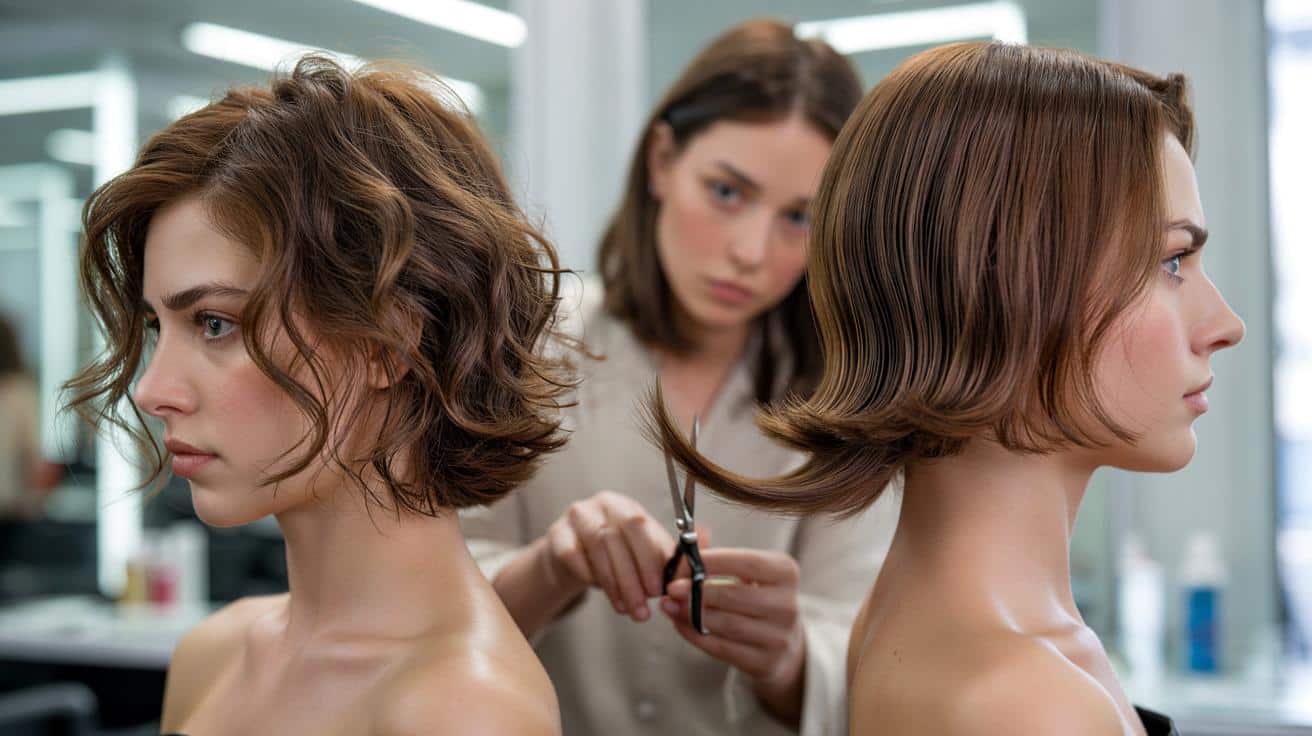
The girl in the salon chair has that look: half defeated, half hopeful. She arrived with her hair in a messy bun that wasn’t meant to be stylish, just a last resort. Frizz standing up at the crown, random kinks at the back, those two rebel strands at the front that never lie flat. Her stylist runs a comb through it, and the comb actually hesitates, like it’s thinking about its life choices.
We’ve all been there, that moment when you catch your reflection and think, “What is my hair even doing?”
The stylist doesn’t flinch. She clips, snips, and suddenly the whole energy of the hair changes. One specific cut. One sharp decision.
And the truth is, most “unruly hair” isn’t really the problem.
The wrong cut is.
The one cut stylists quietly rely on for “unruly” hair
Ask three different stylists about difficult hair and many will end up saying the same thing: a structured, slightly layered long bob, worn at or just below the collarbone. Not a heavy, blunt block. Not a thousand wispy layers. A clean, **collarbone-length cut** that has shape, but not chaos.
The collarbone does something magic. It gives your hair a place to land, a soft “shelf” that breaks the weight and movement. Too long and your hair drags, pulling out any natural wave. Too short and it springs up in directions nobody asked for. The sweet spot? That middle zone that lets the hair bend, bounce, and sit.
Take Sophie, 32, whose hair had basically declared independence. Wavy at the back, straight at the front, fluffy at the crown. She spent years fighting it with straighteners and “anti-frizz” creams, and still ended up tying it up by 10 a.m.
One day, her stylist suggested cutting everything to sit between chin and collarbone, with soft, invisible layers only where the hair bulged the most. They removed the heavy, dragging ends but kept the density. No shag, no complicated fringe, just a solid long bob that lightly hugged her jaw and neck.
Three weeks later, Sophie sent a selfie: air-dried hair, subtle bend, no helmet effect. “I actually like leaving it down now,” she wrote. “Didn’t think that was possible.”
There’s a simple reason this cut works on so many “misbehaving” heads. Hair that refuses to behave is often fighting a mismatch: too much length against too little structure, or too much thinning against too few anchor points. The long bob, done right, respects gravity.
➡️ How to create a budget that adapts to real life, not ideal scenarios
➡️ People who struggle with uncertainty often seek emotional grounding
➡️ People who feel calmer alone often regulate emotions internally, psychology says
➡️ If you feel emotionally alert even while resting, psychology explains the learned readiness
➡️ Why feeling tired after a full night’s sleep is more common than you think, and how to fix it
➡️ This overlooked habit makes daily expenses feel smaller than they really are
➡️ The common pruning habit that actually weakens fruit trees over time
➡️ If your flowers bloom unevenly, spacing is often the hidden cause
The weight sits where your hair naturally wants to curve, not where it wants to frizz. Layers are used like seasoning, not like a full recipe: just enough to relax bulk at the ends, without shredding the line.
*Most stylists agree that the worst enemy of unruly hair is the wrong length, not the hair itself.*
How to ask for the cut that calms your hair down
In the chair, words matter. Walking in saying “Do whatever you want” is how some of us ended up with the tragic feathered layers of 2011. For hair that misbehaves, be precise: ask for a one-length or slightly layered **long bob that hits between your collarbone and the top of your chest**.
Mention that you want movement, not volume at any cost. Ask your stylist to keep the perimeter line strong, then add very soft, internal layers only where your hair tends to puff or form a triangle. If your hair is wavy, ask that they cut it at least slightly dry at the end, so they see its real behavior, not the brushed version.
So many people with “problem hair” arrive at the salon already apologizing. They say, “My hair is awful” or “Nothing works on it.” The stylist hears that, and sometimes they over-correct: thinning shears everywhere, layers going in all directions, a fringe that looks cute for two days and then… not.
A calmer approach works better. Bring photos of collarbone-length cuts on people whose hair texture feels vaguely like yours. Say clearly what you don’t want: “No heavy thinning at the ends”, “Nothing shorter than my jaw”, “I still want to be able to tie it back”. Let your stylist guide you, but hold your ground on the overall shape. Let’s be honest: nobody really styles their hair perfectly every single day.
“When someone tells me their hair ‘refuses to behave’, I almost always shorten it to the collarbone and rebuild the base,” explains Paris-based stylist Julien M. “Once the shape is right, the hair suddenly looks like it’s cooperating. It wasn’t the hair. It was the cut.”
- Ask for a collarbone-length base
So the hair benefits from gravity without being dragged down. - Keep layers soft and internal
To reduce bulk without creating choppy, unmanageable ends. - Skip aggressive thinning
On unruly hair, it often increases frizz and flyaways. - Think about your real-life routine
Choose a shape that looks decent even when you just rough-dry. - Book a tiny maintenance trim every 8–10 weeks
The cut stays in its “sweet spot” and your hair behaves longer.
Living with the cut: from daily battle to light maintenance
Once the shape is right, daily life gets easier, not more complicated. The collarbone bob is forgiving: it can be rough-dried upside down for a bit of volume, then smoothed with just your hands and a drop of cream. On wavy hair, scrunching in a light mousse and letting it air-dry suddenly becomes a valid option, not a desperate experiment.
The key is to respect the new architecture. No need for ten products or complex routines. A gentle shampoo, a not-too-heavy conditioner on the lengths, a bit of leave-in for frizz, and heat only when you want polish. Many people discover that their “bad” hair has a shape and wave they’d never really seen, because it was always weighed down or overworked.
There’s also a mental shift. With a calmer, more balanced cut, you stop feeling like your hair is a daily exam you keep failing. You can throw it into a low bun and it still looks like a choice, not damage control. Half-up styles work better, because the line at the back is clean.
Of course, some days it will still do its own thing. That’s hair. But the fight is less intense, less time-consuming. You start trusting that your hair will look “good enough” even when you’re just trying to get out the door. Sometimes, that’s the real luxury.
This kind of cut also leaves space for evolution. You can grow it longer once the base is balanced. You can add a light curtain fringe later if you feel like changing things without starting from zero. And if you decide to go shorter, you’re doing it from a solid structure, not from a shapeless mass.
The people who get on best with their hair are rarely those with “perfect” texture. They’re the ones who found that quiet middle road: a length that works with their natural pattern, a cut that respects gravity, a routine that fits how they actually live. When a stylist recommends the collarbone bob for hair that refuses to behave, that’s what they’re really offering: a truce.
| Key point | Detail | Value for the reader |
|---|---|---|
| Collarbone-length base | Hair sits between jaw and upper chest, using gravity without dragging | Reduces puffiness and frizz while keeping natural movement |
| Soft, internal layers | Light removal of bulk inside the cut, not on the outer line | Prevents the “triangle” effect and keeps ends looking healthy |
| Realistic styling routine | Simple products, minimal heat, cut tested on almost air-dried hair | Makes hair manageable on busy mornings and less dependent on tools |
FAQ:
- Question 1Is the collarbone-length bob suitable for very thick, frizzy hair?
- Answer 1Yes, as long as the stylist controls bulk with internal layers instead of extreme thinning at the ends. The strong base helps the hair fall in a cleaner line.
- Question 2Will this cut work if my hair is very fine and flat?
- Answer 2It can, especially if the ends are kept blunt and layers are minimal. The length at the collarbone adds weight while the clean outline gives the illusion of density.
- Question 3Do I need bangs for this cut to look good?
- Answer 3No. Many people with “difficult” hair do better starting without bangs. You can always add a soft, curtain-style fringe later once you’re used to the shape.
- Question 4How often should I trim a collarbone-length bob?
- Answer 4Every 8–10 weeks is usually enough to stay in the optimal length zone, before the hair grows too long and starts dragging the shape down.
- Question 5Can I still tie my hair up with this length?
- Answer 5Yes, you can do low ponytails, small buns, and half-up styles. Very high ponytails might be trickier, but most people keep enough length to clip it back comfortably.