The first thing I noticed was the silence. No podcast in the background, no timer blinking at me from the oven, no frantic juggling between two screens and a chopping board. Just the soft crackle of onions melting in olive oil and the quiet creak of my wooden spoon against a cast-iron pot. Outside, the late afternoon light was sliding down the buildings. Inside, everything smelled like home, even though I wasn’t rushing to get there.
I’d decided, almost stubbornly, to cook this one meal without multitasking, without scrolling, without watching the clock. Just me, the recipe half-remembered from childhood, and the slow pulse of a simmering sauce.
What surprised me most was not the taste.
It was who I became while it cooked.
The day I finally stopped racing my own dinner
Most weeknights, dinner feels like a race where the finish line keeps moving. You’re chopping with one hand, texting with the other, half-listening to someone talk about their day, and already thinking about the dishes you’ll deal with later. The flame is always a bit too high, the pasta is always a minute too cooked, and you eat standing at the counter because sitting feels like a luxury.
That evening, I did the opposite. I turned the heat down. I slowed my hands. I let the sauce take its time. And quietly, everything in me started to follow.
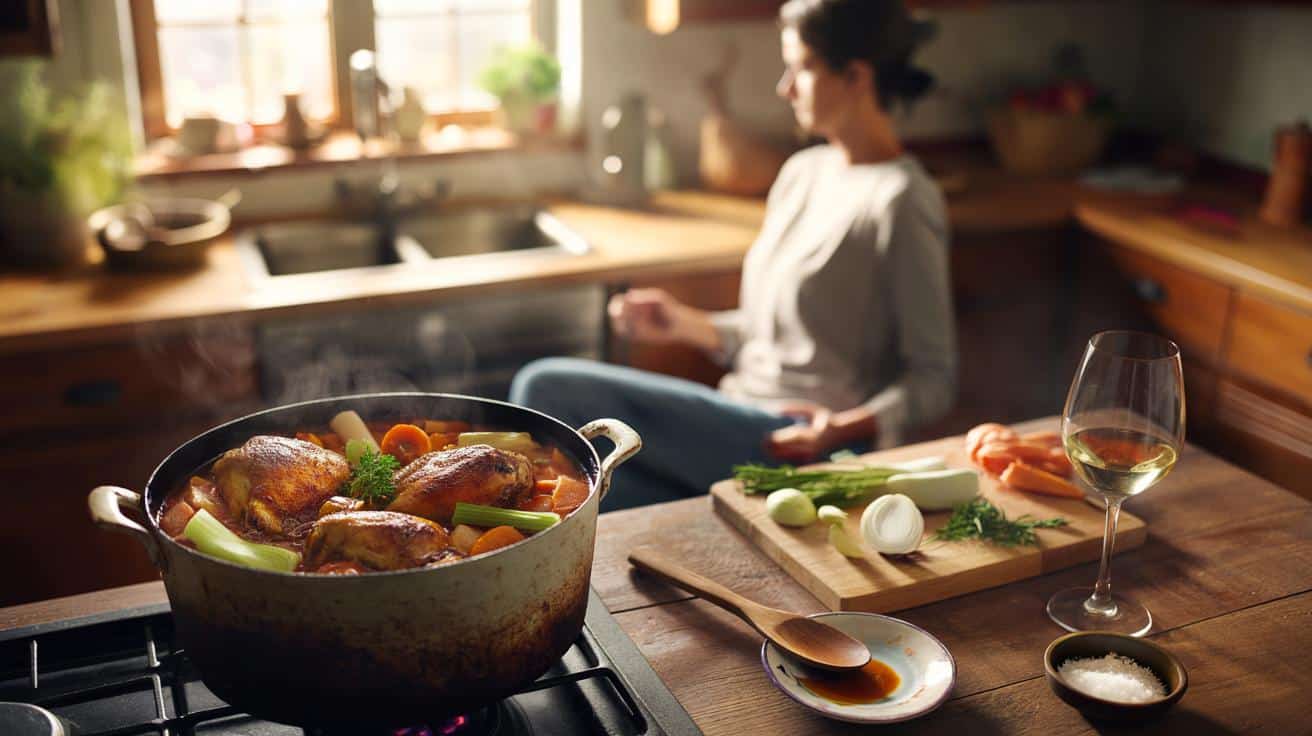
The meal itself was simple: a kind of lazy Sunday-style braised chicken, even though it was a Thursday. Bone-in thighs, seared until the skin browned and whispered when it touched the pan. Onions and garlic, softened until they slumped. Carrots, celery, crushed tomatoes, a splash of white wine that hissed like a small argument then calmed.
Normally I’d rush this, crank the flame, throw a lid on, and hope for the best. That night, I didn’t. I browned the chicken in batches instead of overcrowding the pan. I waited for that deep, nutty smell that only comes when you’re patient. I scraped every brown bit off the bottom like it was treasure. And when I poured the liquid in and lowered the heat, I actually watched it come to a gentle, steady simmer.
What changed was not some magical technique from a fancy cookbook. It was timing. Low heat gives flavor time to build, collagen time to melt, vegetables time to sweeten. Rushing cooking is like fast-forwarding a song and then wondering why it doesn’t sound right.
The chicken turned tender because the fibers slowly relaxed instead of seizing up. The sauce thickened naturally, no flour needed, just evaporation and patience. And something else softened in the room. The conversation. The shoulders. The constant urge to glance at a screen. In a way, the meal tasted better because, for once, we’d given it permission to.
The quiet craft of slow, comforting food
If you want to feel this shift yourself, start smaller than “perfect Sunday roast.” Pick one comforting dish that can handle taking its time: a stew, a soup, a baked pasta, even a tray of roasted vegetables. Then commit, silently, to doing each step a bit slower than you usually do. Not dramatically. Just enough that you actually notice your own hands.
➡️ The common pruning habit that actually weakens fruit trees over time
➡️ If you feel emotionally alert even while resting, psychology explains the learned readiness
➡️ People who struggle with uncertainty often seek emotional grounding
➡️ Why feeling tired after a full night’s sleep is more common than you think, and how to fix it
➡️ People who feel calmer alone often regulate emotions internally, psychology says
➡️ This overlooked habit makes daily expenses feel smaller than they really are
➡️ Stylists recommend this cut for hair that refuses to behave
➡️ How to create a budget that adapts to real life, not ideal scenarios
Salt the meat early and let it rest on the counter while you chop. Let the onions go past “soft” into that golden, translucent stage where they smell like the beginning of every good memory. Taste as you go, not like a critic, but like someone checking in on a friend. And once the pot is simmering, resist the urge to blast the heat. Let the bubbles be small and regular, like a sleepy breathing pattern.
The biggest trap is thinking slow cooking is about perfection. It isn’t. It’s about presence. Food still sticks sometimes. You still forget the herbs until the end. You might slightly overcook the rice. That’s real life.
We’ve all been there, that moment when you scorch the garlic because you answered a message “just for a second” and now dinner smells vaguely like regret. The answer isn’t guilt. It’s deciding, once in a while, to give a meal your full, unbroken attention for an hour. Let’s be honest: nobody really does this every single day. But choosing one night a week changes your relationship with your kitchen more than any expensive pan ever will.
Sometimes the most comforting ingredient in a recipe isn’t butter or cheese or cream.
It’s the feeling that, for this one meal, you didn’t rush your own life.
- Brown without fear
Give meat and vegetables space in the pan. Let them sit until they release on their own, instead of poking and flipping too early. - Deglaze like you mean it
Pour wine, stock, or even water into the hot pan and scrape every browned bit. That’s where the flavor hides when you’re not looking. - Trust a gentle simmer
Big, aggressive bubbles can turn tender cuts tough. Tiny, persistent bubbles build depth and softness, both in food and in mood. - Season in layers
A pinch of salt at the start, a taste in the middle, a tiny correction at the end. One heavy-handed dump at the table rarely saves a rushed dish. - Protect the quiet
Turn off the TV. Put your phone in another room. Let chopping, stirring, and the smell of dinner be the main event, just this once.
When a slow meal changes more than just the plate
What stayed with me from that unhurried dinner wasn’t just how the chicken slid off the bone or how the sauce clung to the rice. It was the way time felt thicker, almost stretched. The kitchen light was softer. The conversation at the table wandered instead of rushing to the point. No one ate standing up. No one reached for a screen.
*The food seemed to say, “You waited for me. I’ll stay with you, too.”* And maybe that’s why it felt so comforting. Not because the recipe was fancy, but because, for one evening, time and attention were part of the ingredients.
| Key point | Detail | Value for the reader |
|---|---|---|
| Slowing the process | Cooking on lower heat, in stages, without multitasking | Leads to deeper flavors and a calmer, more grounded mood |
| Choosing “forgiving” recipes | Stews, soups, braises, and baked dishes that welcome long simmering | Makes it easier to practice slow cooking without stress or fear of failure |
| Protecting attention | Cooking one meal a week phone-free and distraction-free | Turns dinner into a small ritual of rest instead of another rushed task |
FAQ:
- Question 1Does cooking slowly really change the flavor that much?
- Question 2How do I cook slowly if I get home late from work?
- Question 3What are some easy “slow comfort” meals for beginners?
- Question 4Is slow cooking the same as using a slow cooker appliance?
- Question 5How often should I aim for this kind of unhurried meal?