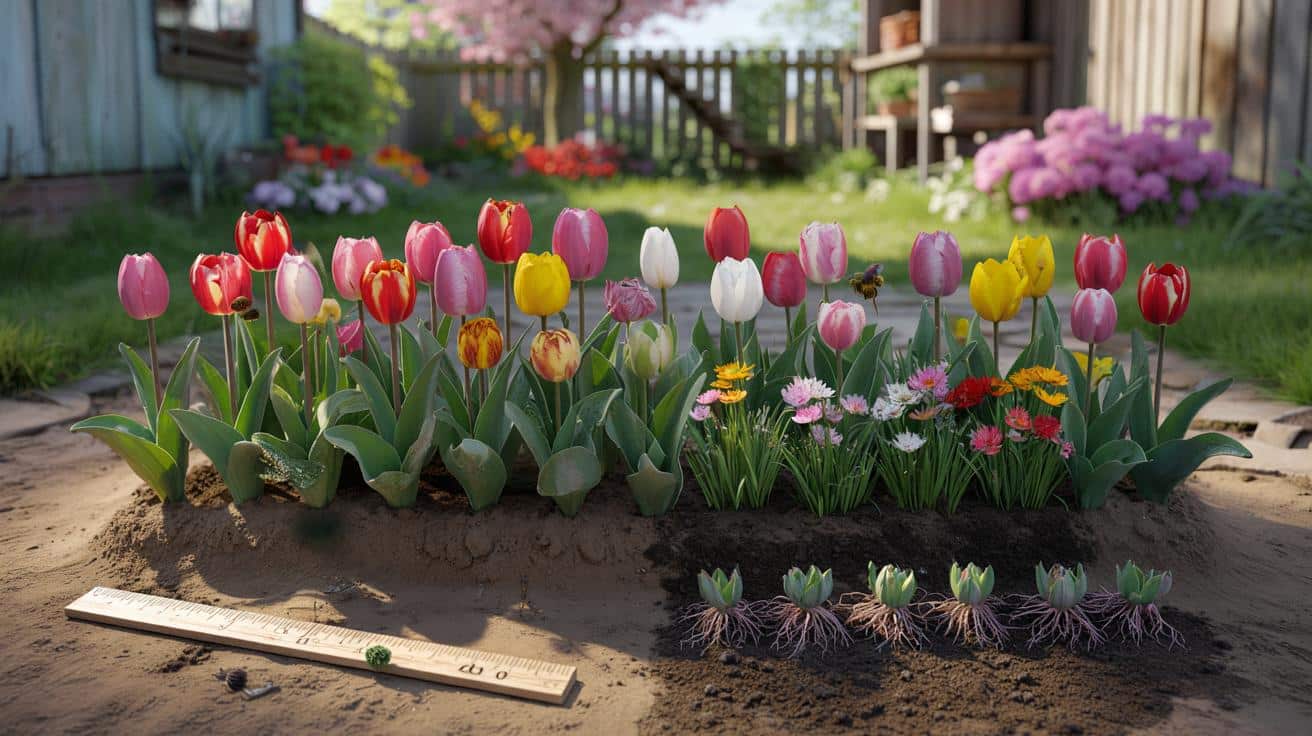
The first thing you notice isn’t the color, it’s the timing. One corner of the border is exploding with petals, buzzing with bees, almost showing off. Two meters away, the same plant variety is just… stems and tight green buds, like it missed the memo. You water the whole bed, you added the same compost, the sun hits the whole area. So why does one clump party while the next one is still getting dressed?
Walk through any neighborhood in spring and you’ll see it: a weird patchwork of early, late, and “maybe next week” flowers in the very same row. Gardeners blame the weather, the soil, the moon, sometimes even themselves. Yet there’s a quieter culprit that rarely gets named.
It starts long before the first bud appears.
When blooms fight for space instead of light
Stand over a bed of perennials and look straight down. The story is written at soil level. Crowded clumps, leaves overlapping, stems elbowing each other for room. A neat row from above suddenly looks like a traffic jam, with every plant trying to push through the same narrow lane. When flowers bloom unevenly like this, gardeners often stare at the tops. The real plot twist is happening in the roots.
Plants that are too close don’t grow at the same speed. Some dominate, some lag, and the bloom calendar goes out of sync.
Picture a row of tulips planted one rushed Sunday in October. At the left end, the gardener followed the tag: 10 cm apart, same depth, straight line. By the time they got to the right side, it was getting dark and cold. The bulbs went in wherever they fit, some almost touching, some buried shallower than others. Fast forward to April: the left side is a harmonious line of tulip cups, all open within three days of each other. The right side looks random. One early flower, two half-sized stems, a bald gap, then a cluster that blooms a whole week late.
Nothing “mystical” happened over winter. Spacing did.
When plants grow too close, the strongest roots grab water and nutrients first. They heat up faster in spring, they push leaves earlier, and they’re ready to flower ahead of the rest. The weaker plants, squeezed or shaded, act like they live in a different climate zone. For them, spring starts later, the stress is higher, and the flowering clock shifts. Uneven spacing means uneven access to air, light, and food. That’s why one side of a border can look like late May while the other still thinks it’s April.
How to use spacing as your secret blooming lever
Start with one simple gesture: measure the gap before you dig. Not with an app, not by guessing, but with something you can actually drop on the soil. A hand-width, a small stick, a piece of wood marked with a pen. This low-tech ruler keeps you honest when you’re tired, cold, or tempted to squeeze in “just one more plant.” Seed packets and plant labels usually give two distances: one for rows, one for between plants. Use the plant-to-plant spacing as your anchor. It’s boring, it’s repetitive, and it’s exactly what gives you that wave of buds that opens almost together.
*Spacing is the unglamorous step that quietly decides how your flowers will behave later.*
➡️ If you feel emotionally alert even while resting, psychology explains the learned readiness
➡️ People who feel calmer alone often regulate emotions internally, psychology says
➡️ This overlooked habit makes daily expenses feel smaller than they really are
➡️ How to create a budget that adapts to real life, not ideal scenarios
➡️ I cooked this comforting meal without rushing and it showed
➡️ Stylists recommend this cut for hair that refuses to behave
➡️ The common pruning habit that actually weakens fruit trees over time
➡️ People who struggle with uncertainty often seek emotional grounding
There’s a classic trap many home gardeners fall into: planting for how the bed looks the day you put everything in. Tiny nursery plants in big beds create panic. The urge is to close gaps, to fill every empty spot, to avoid that “sparse” first season. The problem is that most plants don’t stay tiny. They fill out, they stretch, they lean into each other until “cozy” turns into “suffocating.” Uneven blooming is one of the first warning signs, even before disease or yellowing leaves.
We’ve all been there, that moment when you dig up a plant and discover the roots have been twisted around their neighbors like headphone cables.
“If you want flowers to bloom at the same time, think about the distance between them the way you’d think about seats at a dinner table,” says a landscape designer I met who regularly rescues overstuffed beds. “Too close and someone ends up eating with their elbows tucked in.”
- For bulbs – Follow the “three times the bulb’s height” depth rule and keep a consistent gap between each one, not just “more or less.”
- For perennials – Check the mature width on the label, then plant for that future width, not the pot size you see in your hand.
- For annuals in pots or boxes – Leave enough space for airflow so foliage dries quickly after rain. This limits stress and keeps blooms more regular.
- For shrubs – Think in circles. Each shrub needs its own invisible circle of room underground and above, so flowering branches don’t have to fight through a tangle.
- For mixed borders – Group plants with similar vigor and height together, so one bully doesn’t steal all the space and throw off the shared blooming rhythm.
When uneven flowers become a quiet invitation
Once you start seeing spacing as a blooming lever, your garden stops looking like a disappointment and starts reading like feedback. That late peony in the corner isn’t “lazy”; it’s crowded between a fence and a greedy shrub. The lopsided row of marigolds isn’t cursed; half of them are pressed up against the path where soil dries out faster. Gardening gets calmer when you realize the problem is often just centimeters, not your talent.
Let’s be honest: nobody really measures every planting distance every single day. Life is messy, we squeeze things in, we change our minds mid-dig. The trick is to use uneven flowering as a gentle nudge, not a verdict. When one side of your bed blooms early and the other stays behind, you’ve just been handed a free map of where roots are competing, where plants need dividing, or where a small reshuffle could create a smooth, satisfying wave of color next season. The flowers are talking in their own way. The question is: how will you answer?
| Key point | Detail | Value for the reader |
|---|---|---|
| Spacing changes bloom timing | Too-tight plants compete for roots, water, and light, so some flower early while others lag behind | Helps explain mysterious uneven flowering in a simple, fixable way |
| Plant for mature size | Use label widths and simple measuring tricks instead of planting for how the bed looks on day one | Prevents overcrowding and keeps flowering more synchronized over time |
| Uneven blooms are feedback | Late or weak flowers often point directly to crowded zones that need dividing or moving | Turns frustration into a practical tool for improving the garden each season |
FAQ:
- Why do only some of my flowers bloom while others stay leafy?Often the blooming ones have slightly more space for their roots or better airflow, so they experience less stress and can reach flowering stage sooner.
- Can I fix uneven flowering without replanting everything?Yes. You can thin out the most crowded spots, divide overgrown clumps, and move just a few “bullies” to give weaker plants a bit more room.
- Does spacing really matter if I fertilize regularly?Fertilizer helps, but it can’t solve root crowding or poor air circulation. Plants still need physical room to build balanced foliage and buds.
- How far apart should I plant for better bloom timing?Follow the label or seed packet, then add a little extra distance if your soil is heavy or your climate is humid, since plants will fill out more.
- Is uneven sun or shade more important than spacing?Light matters a lot, yet spacing decides how well each plant can use the light it gets. Both work together, but crowding will disturb flowering even in perfect sun.