On a pale March morning, when the ground is still cold but the light has that first brave warmth, you can hear it before you see it: the clipped rhythm of secateurs in a suburban garden.
A neighbor leans into an old apple tree, snipping confidently, twigs falling like confetti at their boots. They look pleased, almost heroic, as if they’re doing the tree a favor. “Got to keep it under control,” they say, barely glancing up.
By summer, though, that same tree looks strangely tired. Lots of leaves, yes. But fruit? Small, scattered, and late. Branches shoot straight up like antennae, all growth, no generosity. The owner shrugs, blames the weather, the variety, anything but the way those cuts were made. The sad part is that this scene plays out in thousands of gardens every year.
Because there’s one hugely common pruning habit that slowly weakens fruit trees. And it looks “right” at first glance.
The “short back and sides” pruning habit that quietly drains your trees
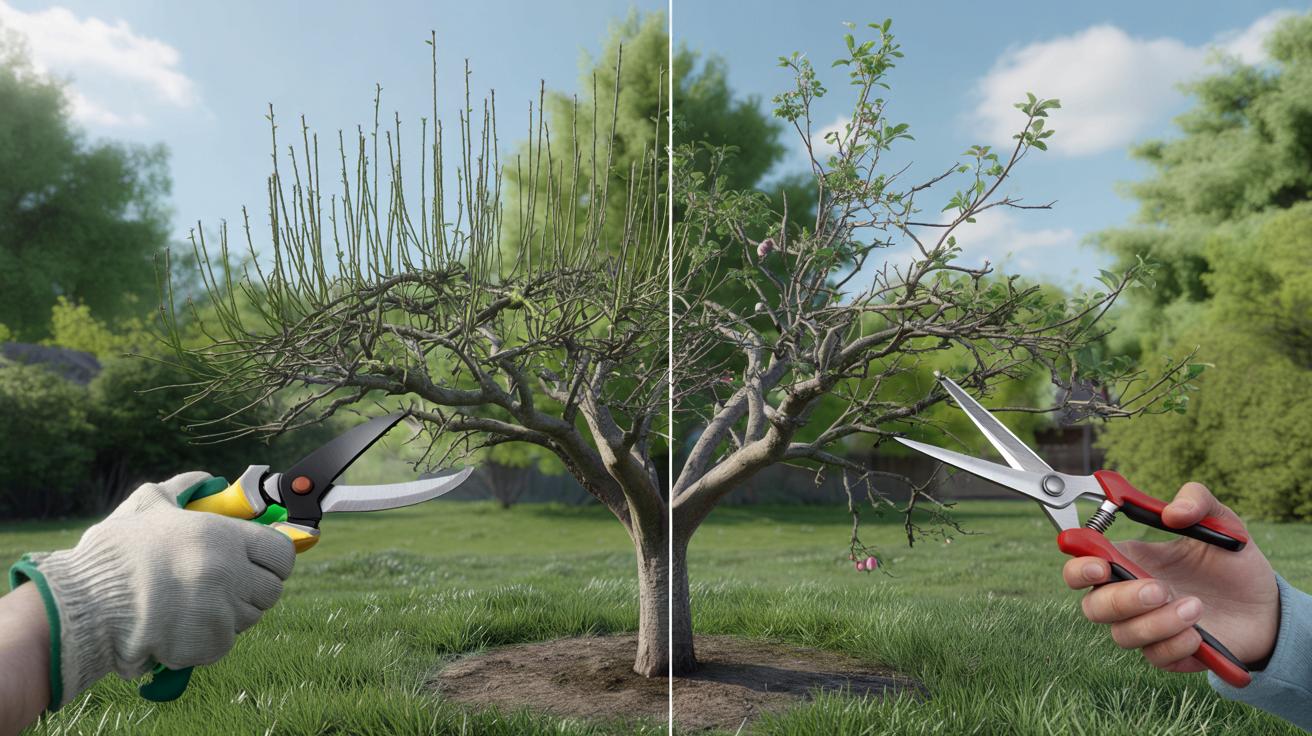
Walk through any allotment or small-town backyard in late winter and you’ll spot it instantly: fruit trees clipped into tight little shapes, every branch shortened, every tip chopped back. It’s the gardening equivalent of a military haircut. Neat, symmetrical, oddly satisfying to look at. People call it “tidying up” or “giving it a good prune,” and they usually do it once a year, often on the same weekend they clean the gutters.
The logic sounds simple. Shorten branches, get a stronger tree. Cut back growth, get more fruit. The secateurs go automatically to the ends of each shoot, snipping a bit off here, a bit off there, until the whole tree looks more compact. There’s a sense of control, of having “done the job.” The problem is that this yearly ritual of systematic tip pruning is exactly what sets the tree on a long, slow path to weakness.
Picture your tree like a small factory. The leaves are the workers, the branches are the conveyor belts, and the trunk is the main line. When you cut every branch tip each year, you fire half the experienced staff and rearrange the entire production line. The tree responds with panic growth: long, vertical shoots racing up to rebuild what was lost, but with less energy for fruiting wood. Over time, a cycle kicks in. You cut hard, it reacts with chaotic growth, you cut again, it panics again. The root system never quite catches up, reserves are used up, and the tree stays stuck in adolescence instead of maturing into a calm, fruit-heavy adult.
What to do instead: prune for structure, not for control
The gentler, smarter approach to pruning fruit trees looks almost lazy from the outside. Instead of clipping every tip, you focus on shaping the tree’s skeleton and letting much of the smaller growth stay. The first question isn’t “What can I cut?” but “Which few cuts will change the structure the most?” You start by stepping back, really looking at the tree. Where is it too crowded? Which branches rub against each other or grow inward? Which big limbs are shading everything below?
Most of the useful work happens with just a handful of cuts. Remove one or two large, badly placed branches right back at the base. Open up the center to let light in, especially for apples and pears. Leave many of the shorter lateral branches alone, since those are the ones that carry flower buds and future fruit. Suddenly the tree can breathe, carry light throughout the canopy, and invest in fruiting spurs instead of endless new whips. The whole thing feels less like a haircut and more like a thoughtful edit.
This is where so many keen gardeners get tripped up, and it’s rarely from lack of care. They worry the tree will “get away” from them if they don’t cut everything back every winter. They’re afraid of making big cuts, so they keep doing lots of small ones that feel safer. Over time, that fear shapes the tree more than any book or tutorial. The plain truth is: a few well-placed, slightly bolder cuts are kinder to the tree than dozens of nervous little snips.
As one old orchardist told me on a damp February afternoon, watching a novice go to town on a pear tree: “Prune with a reason, not with a habit. Every cut should earn its place.”
➡️ This overlooked habit makes daily expenses feel smaller than they really are
➡️ People who struggle with uncertainty often seek emotional grounding
➡️ If you feel emotionally alert even while resting, psychology explains the learned readiness
➡️ If your flowers bloom unevenly, spacing is often the hidden cause
➡️ People who feel calmer alone often regulate emotions internally, psychology says
➡️ How to create a budget that adapts to real life, not ideal scenarios
➡️ I cooked this comforting meal without rushing and it showed
➡️ Why feeling tired after a full night’s sleep is more common than you think, and how to fix it
To keep that in mind on a cold day with numb fingers and muddy boots, it helps to have a small mental checklist, a sort of “pruning brake” before you act:
- Look from a distance first: does the tree have a clear shape or just a dense blob?
- Find branches that cross or rub: remove the weaker or more awkward one.
- Open light channels: create gaps where sunlight can reach the lower branches.
- Respect fruiting wood: keep short, horizontal laterals that carry buds.
- Limit yourself: aim for fewer, more meaningful cuts each year.
*Once you start pruning like this, you realize how often we cut to calm our own anxiety, not to help the tree.*
Living with slower, stronger trees
There’s a quiet shift that happens when you stop giving fruit trees that annual “short back and sides” and start pruning for long-term strength instead. The tree looks less manicured at first. Some branches are longer than you’d like. The shape isn’t Instagram-ready every single winter. Yet something else appears: calmer growth, sturdier limbs, more blossom clustered along older wood. The tree begins to look less like a project and more like a companion that’s finally allowed to grow up.
We’ve all been there, that moment when you stand in front of a tree with secateurs in your hand and feel that itch to “do” something. Silence can feel like neglect. Leaving good wood uncut can feel wrong when every gardening show screams “prune, prune, prune.” Let’s be honest: nobody really reads the full pruning chapter and practices every step carefully in the cold wind. Most of us learn from half-remembered advice, a YouTube video, or a neighbor’s routine.
So maybe the real habit to break isn’t just tip pruning. It’s the idea that trees must always be controlled, shortened, tidied on a fixed schedule. A strong fruit tree is a long story: a handful of careful cuts this year, a few more in three years, a branch removed a decade from now when it’s finally done its job. If there’s a new rule to learn, it might be this: cut less, look more, and let the tree tell you what it needs instead of your secateurs deciding for it.
| Key point | Detail | Value for the reader |
|---|---|---|
| Stop routine tip pruning | Constantly shortening every branch tip triggers weak, panic growth and fewer fruits over time | Helps you avoid the most common pruning mistake that slowly drains tree vigor |
| Prioritize structure over tidiness | Focus on a few major cuts to open the canopy, remove crossing limbs, and protect fruiting wood | Leads to healthier trees that carry more reliable, better-quality harvests |
| Adopt a slower rhythm | Observe from a distance, prune with a clear reason, and accept slightly wilder shapes | Reduces stress, saves effort, and builds long-term resilience in your orchard or backyard |
FAQ:
- Question 1What exactly is “tip pruning” and why does it weaken fruit trees?
- Answer 1Tip pruning means routinely cutting back the ends of most or all branches every year. This removes a lot of buds and growth points, pushing the tree to respond with fast, vertical shoots instead of calm, fruiting wood. Over time, that constant stress uses up energy reserves and leaves the tree more focused on survival growth than on producing good harvests.
- Question 2How often should I prune my apple or pear tree?
- Answer 2Most mature apples and pears only need a light structural prune once a year, sometimes even every second year if you’ve already built a good framework. The key is consistency, not intensity. A few thoughtful cuts in late winter are usually enough, instead of a major “chop” every single season.
- Question 3What if my fruit tree is already a dense, tangled mess?
- Answer 3Don’t try to fix years of over-pruning in one go. Start by removing dead, diseased, or obviously crossing branches. Then choose one or two big branches to take out to open the structure. You can repeat the process gently over several winters, giving the tree time to adjust and rebuild without shock.
- Question 4Will I still get fruit if I prune less?
- Answer 4Yes, and often you’ll get better fruit. By keeping more horizontal, short laterals and reducing panic growth, the tree can invest in flower buds and fruiting spurs. The harvest may be steadier, with fewer boom-and-bust years, and the fruit often has better color and flavor because more light reaches it.
- Question 5Is the same rule true for stone fruits like plums and cherries?
- Answer 5The principle is similar: avoid aggressive yearly tip pruning. Plums and cherries often respond badly to heavy winter cuts, so many growers prune them lightly in summer when the risk of disease is lower. Again, the focus is on removing whole problem branches and preserving fruiting wood, rather than shortening everything for neatness.