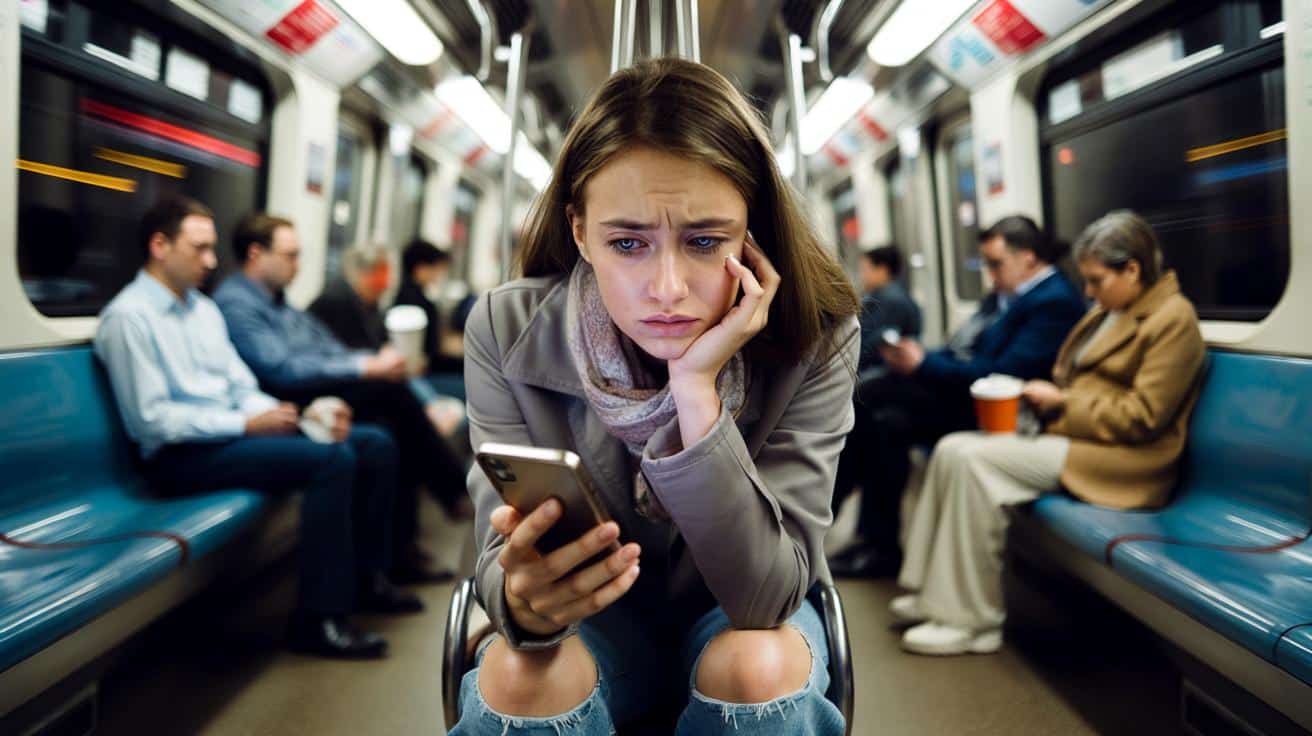
On the subway, she scrolls through her phone with that tense, staccato thumb movement you recognize right away. News alert, email from her boss, notification from the bank, a vague message from her partner: “We need to talk tonight.” Her jaw tightens almost imperceptibly. The carriage is calm, but inside her chest there is a small, quick storm. She keeps checking the time although nothing is actually late yet.
Around her, people sip coffee and stare out the window. No one sees the way her mind is racing three hours into the future, or three days, or three months. If the boss is angry. If the relationship is ending. If the money won’t stretch. The day hasn’t even started and she’s already exhausted.
Uncertainty doesn’t scream. It hums quietly under the skin.
Why uncertainty feels so heavy for some people
There are people who seem to float through unpredictability like it’s just weather. Plans change, jobs shake, relationships wobble, and they shrug, adjust, move on. Then there are the others. When something is unclear, their whole body goes on high alert. Sleep gets lighter. Thoughts get louder.
They’re not being dramatic. Their nervous system is doing what it was trained to do: scan, predict, prevent. Every “we need to talk,” every delayed reply, every unfamiliar symptom becomes a possible threat that must be solved before it’s real.
Living like this feels like constantly holding your breath.
Psychologists call it “intolerance of uncertainty.” A slightly clinical name for a very human experience. People who struggle with it don’t just dislike not knowing. They feel almost physically unsafe when things are up in the air. Their brain pushes them to seek emotional grounding anywhere they can find it.
That might mean texting friends for reassurance, obsessively researching symptoms, or replaying conversations in microscopic detail. One young engineer I spoke to refreshes his banking app 20 times a day when a project is delayed, as if the numbers could anchor him.
He’s not chasing money. He’s chasing a feeling that something, anything, is solid.
On a brain level, uncertainty removes our favorite drug: prediction. The mind loves patterns and hates blank spaces. When a situation is unclear, the brain tends to fill the gap with worst-case scenarios, because those feel safer to prepare for. Painful, yes, but at least defined.
➡️ The common pruning habit that actually weakens fruit trees over time
➡️ If you feel emotionally alert even while resting, psychology explains the learned readiness
➡️ This overlooked habit makes daily expenses feel smaller than they really are
➡️ Why feeling tired after a full night’s sleep is more common than you think, and how to fix it
➡️ Stylists recommend this cut for hair that refuses to behave
➡️ I cooked this comforting meal without rushing and it showed
➡️ If your flowers bloom unevenly, spacing is often the hidden cause
➡️ How to create a budget that adapts to real life, not ideal scenarios
This is why people who struggle with uncertainty often grab at emotional anchors. A clear answer, a firm decision, a rule, a routine, a person who “knows what to do.” That grounding doesn’t always come from healthy places. It can be a controlling partner, an over-demanding boss, or a rigid belief system that promises certainty in exchange for obedience.
The trade is always the same: freedom for a sense of safety.
Small grounding gestures when the future won’t sit still
One of the most effective tools for people overwhelmed by uncertainty is surprisingly modest. Before hunting for answers, they pause and bring their attention back into their body. Not to meditate for an hour. Just to land.
A simple exercise: feet flat on the floor, back supported if possible. Notice five things you can see. Four things you can touch. Three sounds. Two scents. One taste in your mouth. Then, take one slower breath out than in.
This doesn’t solve the unknown. It quietly tells your nervous system, “Right now, in this exact second, you are physically safe.”
Many people think emotional grounding has to come from a big life decision: quitting the job, ending the relationship, moving cities. Sometimes that’s true. Often, it’s the tiny rituals that actually keep us from spiraling. Drinking a glass of water before checking your phone in the morning. Walking around the block when anxiety spikes instead of opening eight new tabs.
One mother I interviewed for this story described standing at the sink, hands in warm dishwater, naming the objects around her whenever her mind jumped into terrible future scenarios about her sick child. Plate, cup, window, light. “It sounds silly,” she told me, “but it’s the only way I can stay in the same day as my kid.”
Let’s be honest: nobody really does this every single day. But the days you do, the whole tone of the uncertainty shifts.
When I asked a therapist what grounding really meant, she said: “It’s not about being calm. It’s about remembering you’re more than the story in your head in that moment.” That line stayed with me. Grounding isn’t a magic eraser. It’s a reminder that your body, your senses, your values exist outside the storm of what-ifs.
- Slow breath first, decision second
- One small, repetitive action: folding laundry, sweeping, doodling
- Warmth: a shower, a blanket, hands around a mug
- Words that anchor: “Right now, not forever” or “One next step”
- Contact: texting someone “I’m spiraling a bit, can you just say hi?”
When grounding comes from others — and what that changes
For many, emotional grounding doesn’t start inside. It comes from other people. The friend who picks up at midnight. The partner who says, “Whatever happens, we’ll deal with it together.” The colleague who quietly says, “Hey, you’re not going to get fired over this.”
One young man I met described his older sister as his “human anchor.” He sends her voice notes any time he’s waiting for medical results or job news. She doesn’t give advice. She just responds with the same sentence: “You’re still you, no matter what that email says.”
*Sometimes, that’s all people who fear uncertainty really want: proof they won’t disappear if things go wrong.*
There’s a catch, though. When someone has struggled with uncertainty for a long time, they can start to confuse emotional grounding with control. They might push for constant reassurance, demand clear rules in relationships, or insist on detailed plans for every scenario. It can drain both sides.
This isn’t manipulation in the cartoon-villain sense. Often it’s pure survival mode. The problem is that the more you chase absolute safety from the outside, the less you trust your own capacity to cope. You become dependent on other people’s answers, other people’s moods, other people’s stability.
That’s a fragile kind of ground to stand on.
Some people find steadiness in beliefs, spiritual practices, or strong personal values. Others lean into structure: morning routines, clear boundaries, written priorities. These aren’t about pretending life is predictable. They’re about building a base you can return to when everything else feels up in the air.
Real grounding is less “I know what will happen” and more “I know who I’ll be when it happens.” A reader once wrote to me after losing her job unexpectedly. What helped her wasn’t a five-year plan. It was one sentence on a sticky note: “I don’t abandon myself when life scares me.”
That kind of anchor can move with you through almost any storm.
Living with uncertainty without losing yourself
We live in a time where everything seems negotiable, updateable, reversible. Jobs, cities, relationships, even identities. For people who already feel shaky in the face of the unknown, this can feel less like freedom and more like standing on a permanent cliff edge.
Yet there’s a quiet shift that happens when you stop trying to kill uncertainty and start learning to stand near it. When you say, “I might never love this, but I can learn not to run from it in panic every time.” The fear doesn’t vanish. It becomes one voice in the room, not the only one.
You start to notice the small certainties that were there all along: the way your dog’s paws sound on the floor. The cafe that remembers your order. The value you will not negotiate on, regardless of who stays or leaves. These are not big, dramatic solutions. They are small, loyal facts of your life.
Uncertainty is not a personal failure. It’s the default setting of being alive. Some of us just feel its edges more sharply and search harder for emotional ground. Maybe that’s not a flaw. Maybe it’s a sign of how deeply we care about what happens next.
What would change if, instead of asking, “How do I make everything certain?”, the question became, “What do I need to feel held while I don’t know?” That’s a much more human question. And it’s one that doesn’t need a perfect answer to start softening the day.
| Key point | Detail | Value for the reader |
|---|---|---|
| Grounding starts in the body | Use sensory exercises, slow breathing, and small rituals to calm the nervous system before making decisions | Reduces spirals and panic, makes uncertainty feel more manageable in daily life |
| Relationships can steady or trap | Seeking reassurance is natural, but relying only on others for stability can create dependence and tension | Helps notice when support is healthy vs. when it slides into control |
| Values are portable anchors | Clarifying “who I want to be” matters more than predicting “what will happen” | Gives a sense of continuity through job changes, health scares, and emotional upheavals |
FAQ:
- Question 1How do I know if I have a low tolerance for uncertainty?
- Question 2Are grounding techniques just a trend or do they really work?
- Question 3What if I always need reassurance from my partner or friends?
- Question 4Can therapy actually change how I react to uncertainty?
- Question 5Is it possible to accept uncertainty without becoming passive?